
If you've ever hesitated to add more beans to your plate because of their reputation, you're not alone. Beans have carried that reputation for decades. It's a cultural joke at this point.
And yet, here I am, fully and unapologetically obsessed with beans.
If you've been around here for a while, you know I cook with beans constantly. They're affordable, versatile, and one of the most practical ways to add protein and fiber to a meal. So when I kept hearing people say, "I love beans, but they don't love me back," I decided to dig into it.
Is it really true that beans cause gas?
Is there something unique about them?
And more importantly, is there a way to make them easier to eat comfortably?
As it turns out, there is a very clear explanation for what's happening. It's simply digestion doing what digestion does.
Before we get into strategies for minimizing discomfort, let's talk about what's actually going on inside your body when you eat beans.
What's Actually Causing the Gas?
Beans contain a type of carbohydrate called oligosaccharides, specifically raffinose and stachyose. These are short chains of sugars that your body cannot fully break down in the small intestine because we do not produce enough of the enzyme needed to digest them.
So what happens instead?
Those carbohydrates move into the large intestine mostly intact. Once they arrive there, your gut bacteria get to work. They ferment those carbohydrates as fuel. Fermentation naturally produces gas as a byproduct. That is where the bloating or increased gas can come from.
This is not unique to beans. Any time you increase fermentable fiber or certain carbohydrates in your diet, the same process can happen. Beans simply get the spotlight because they contain both fiber and these specific fermentable carbohydrates.
And here is the part that often gets left out of the conversation: fermentation is not a bad thing. It is part of a healthy, functioning digestive system. Your gut bacteria are doing their job. In fact, many researchers describe these compounds as prebiotic, meaning they feed beneficial gut microbes.
So while the experience may feel uncomfortable at first, the underlying process is normal and, in many ways, a sign that your digestive system is adapting and working.
Give Your Fiber Time
The short answer is yes.
When you increase your intake of fiber from any source, not just beans, it is common to notice temporary bloating or gas. Your gut bacteria shift in response to what you are feeding them. As those microbes adapt to a higher-fiber environment, many people notice that symptoms decrease over time.
Clinical and nutrition research consistently shows that gradual increases in dietary fiber allow the digestive system to adjust more comfortably. This is true whether that fiber is coming from beans, whole grains, vegetables, or fruit.
In other words, it is not that beans are uniquely problematic. It is that many of us simply are not used to eating as much fiber as beans provide. In fact, according to the USDA Dietary Guidelines for Americans, more than 90 percent of women and 97 percent of men do not meet the recommended intake for dietary fiber.
If you currently eat very little fiber and suddenly add a large serving of beans, your digestive system may protest a bit. If you increase slowly and consistently, your body is far more likely to adapt.
This is one of those moments where the uncomfortable reputation of beans tells only part of the story. Often, what people are experiencing is their gut microbiome adjusting to a more fiber-rich pattern of eating.
How to Minimize Discomfort from Oligosaccharides
Now let's get practical.
If oligosaccharides are part of the reason beans can cause gas, are there ways to reduce their impact? Yes.
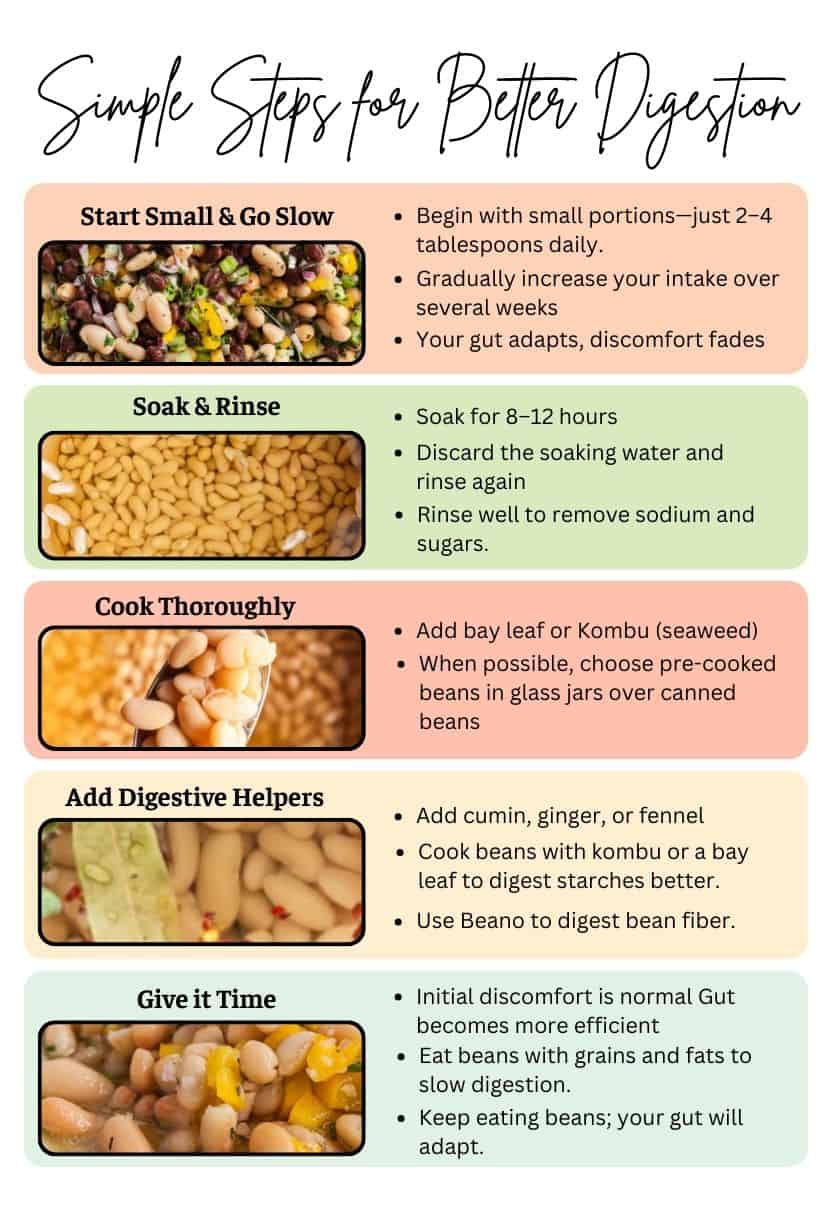
1. Start Smaller Than You Think
If beans are not a regular part of your diet, begin with a half cup serving rather than a full cup or more. Gradual fiber increases are commonly recommended by clinical guidance such as the Mayo Clinic's fiber guidelines. Give your digestive system time to adjust. Consistency matters more than volume in the beginning.
2. Rinse Canned Beans Thoroughly
If you are using canned beans, drain and rinse them well under running water. Some of the soluble carbohydrates that contribute to gas can leach into the cooking liquid. Rinsing removes part of that liquid and may reduce digestive discomfort for some people. Research evaluating preparation methods has shown that draining and rinsing canned legumes can reduce certain fermentable carbohydrates.
3. Soak and Cook Dried Beans Properly
If you cook beans from scratch, soaking dried beans and discarding the soaking water before cooking can help reduce certain fermentable carbohydrates. Research on legume preparation methods suggests that soaking and cooking techniques can decrease raffinose-family oligosaccharide content to varying degrees.
After soaking, cook beans fully until tender. Undercooked beans are harder to digest and can contribute to discomfort.
4. Consider Different Forms
Some people report that beans packaged in glass jars or beans cooked at home feel easier to digest than certain canned varieties. Texture and thorough cooking can influence how well beans are tolerated. Very firm or undercooked beans may be more difficult to digest than fully softened beans, a principle supported by food science research on legume digestibility and preparation methods.
5. Spread Fiber Across the Day
Instead of having a very large serving of beans in one meal, try incorporating smaller amounts across multiple meals. Pairing beans with other foods, such as grains or vegetables, can also help distribute fiber intake more evenly.
The goal is not to eliminate the natural fermentation process. It is to make the transition more comfortable while your body adapts.
For most people, beans do not need to be avoided. They simply need to be introduced thoughtfully.

The Bigger Picture
Beans have earned a reputation that is bigger than the biology behind it.
Yes, they contain fermentable carbohydrates. Yes, your gut bacteria produce gas when they break those down. But that same process is also part of how fiber supports a healthy digestive system, as explained by the Harvard T.H. Chan School of Public Health's overview of dietary fiber and gut health.
Most Americans are not eating enough fiber. Most of us are not regularly feeding our gut microbes the kinds of foods they are designed to handle, a pattern discussed in both the USDA Dietary Guidelines and NIH resources on fiber intake and digestive health. So when we suddenly add a fiber-rich food like beans, the adjustment can feel noticeable.
That does not mean beans are the problem.
It usually means your body is adapting.
When introduced gradually, prepared properly, and eaten consistently, beans can be one of the most practical, affordable, nutrient-dense foods to include in your diet.
If you have avoided beans because of their reputation, consider this your permission to try again, slowly and intentionally. Your digestive system may just need a little time to adjust.
And if you are ready to experiment, you can explore the full bean recipe collection here on Balancing Bowls, where you'll find everything from simple bean salads to hearty soups designed to make beans practical and approachable in everyday cooking.







Did you make this recipe? Let me know!